
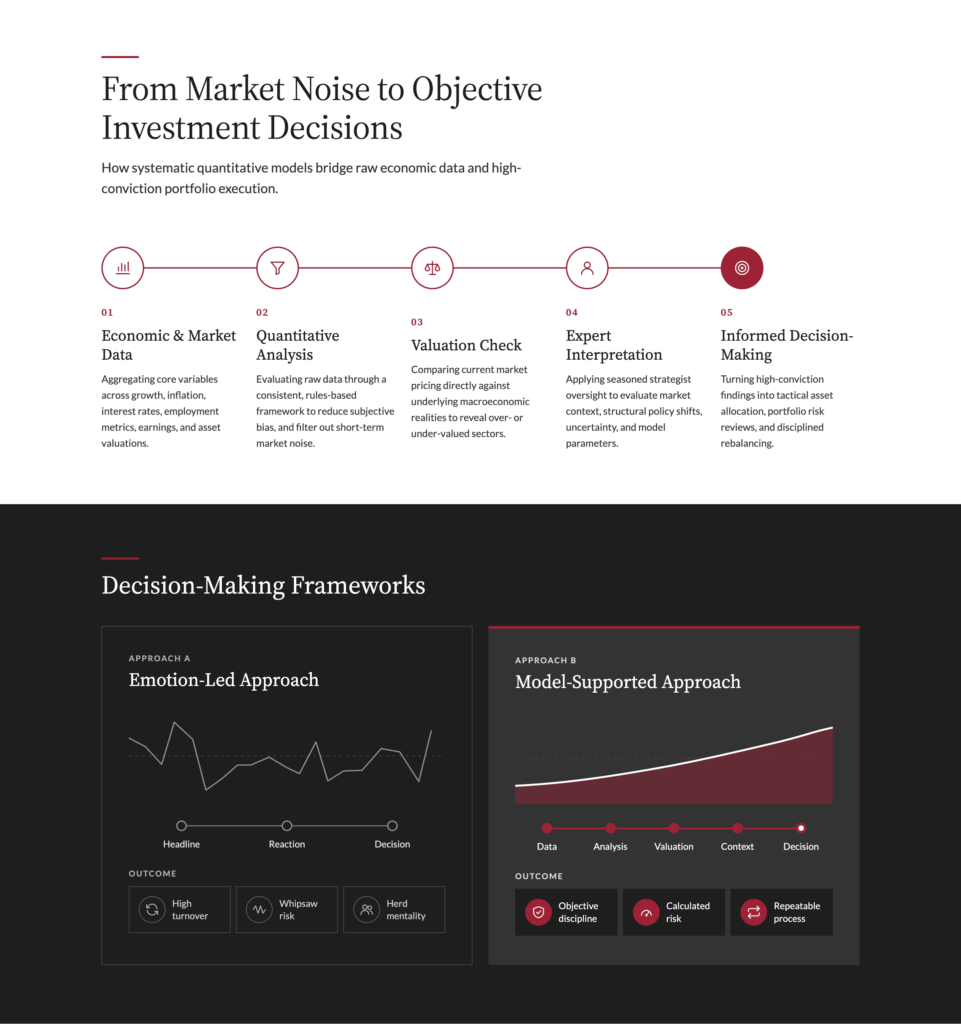
Human bias can be a powerful force. Emotions like fear and greed, along with cognitive traps like confirmation bias, can lead even the most seasoned investors to make irrational decisions. In a market where every headline seems designed to provoke a reaction, how can you find a source of truth that’s objective and free from subjectivity? The answer lies in data.
At Rosenberg Research, our model-driven reports – including our flagship Strategizer and the Industry Ledger models – are built on sophisticated quantitative investment models to provide a systematic, data-driven foundation for your investment decisions. They’re the antidote to gut feel, offering clarity and confidence in a complex world.
Understanding Quantitative Macro Models
At its core, a quantitative macro model is a mathematical framework designed to assess the broader economic landscape without emotional bias. Rather than guessing how interest rates, inflation, or geopolitical shifts might influence prices, these models ingest vast historical and real-time datasets to measure probabilities and relationships across economic cycles.
Modern quantitative investment models help portfolio managers establish a reliable compass by focusing on three essential mechanics:
- Systematic Data Ingestion: Aggregating hundreds of economic variables – from yield curve spreads to industrial production metrics – into a standardized data stream.
- Statistical Relationship Testing: Evaluating how asset classes historically behaved during similar macroeconomic regimes to forecast risk and return profiles.
- Rules-Based Discipline: Removing reactionary impulses by filtering out short-term market commentary in favour of objective, verifiable signals.
Mastering Cross-Asset Allocation with Strategizer
To truly build a resilient portfolio, you need a disciplined, repeatable process. Our Strategizer tool provides just that: a systematic, quantitative view across major asset classes and sectors. Instead of relying on qualitative opinions or a single piece of news, Strategizer uses a robust framework of quantitative macro models to analyze market trends and tactical shifts.
This approach helps subscribers understand how different asset classes – from equities and fixed income to commodities – are positioned relative to one another. Moreover, Strategizer helps to remove the emotional element from investing, leading to more consistent and rational outcomes.
Dissecting Sentiment Versus Fundamentals Through the Industry Ledger
One of the most significant challenges in investing is knowing whether a market move is a true signal or just noise. Our Industry Ledger model tackles this head-on. This cutting-edge tool compares market expectations to economic fundamentals, helping you identify where the market’s collective psychology has outrun reality. The insights from this analysis are presented through dynamic, interactive economic charts, providing a visual representation of the gap between what the market is anticipating and what the data is actually saying.
By analyzing key indicators and their relationship to asset prices, the model helps you recognize when a sector is overvalued or undervalued relative to its macro environment. For example, is the recent surge in a sector based on strong earnings, or is it simply a temporary trend fueled by excessive optimism? The Industry Ledger model answers these questions, allowing you to avoid herd mentality and make decisions based on concrete data instead of speculation.

How Strategizer and Industry Ledger Work Together
Sound investing calls for both a view of the forest and a view of the trees. Each tool stands on its own, but used together, Strategizer and the Industry Ledger form a complete framework, from the macro backdrop down to individual sectors.
Strategizer establishes your core asset mix across stocks, bonds, and commodities based on broad macro conditions. Once that strategic posture is set, the Industry Ledger zooms into granular sector dynamics, pinpointing where consensus views have deviated from underlying fundamentals. This dual approach ensures your portfolio maintains the right structural exposure while exploiting tactical mispricings beneath the surface.
Gaining a Data-Driven Edge in Your Decision-Making
The key benefit of our model-driven reports is that they provide an objective foundation for your investment process. They’re powerful tools for cutting through the psychological biases that can sabotage even the best-laid plans.
Integrating quantitative investment models into your portfolio strategy provides three distinct advantages:
- Reduce Emotional Decision-Making: Our quantitative macro models provide a clear, unbiased signal, so you don’t have to rely on fear, greed, or gut feel.
- Make Confident Choices: When your decisions are backed by data and a systematic process, you gain the confidence to stick to your strategy during volatile times.
- Identify Opportunities Others Miss: The Industry Ledger model helps to uncover subtle mispricings and tactical opportunities that are often missed by investors who rely on traditional analysis alone.
Ultimately, these quantitative tools aren’t meant to replace human judgment but to enhance it. They free you from the time-consuming task of data collection and analysis, allowing you to focus on the strategic decisions that matter most.
Frequently Asked Questions
Understanding how quantitative macro models function alongside traditional portfolio management can help clarify their role in your research stack.
How do quantitative macro models differ from traditional fundamental analysis?
Traditional macro analysis often relies on discretionary interpretations of economic data, policy statements, and consensus forecasts, leaving room for confirmation bias. Quantitative macro models evaluate broad sets of historical and real-time indicators through fixed, rules-based algorithms to measure asset valuations and probabilities objectively.
Do quantitative investment models replace portfolio manager discretion?
No. These models are engineered to support, not replace, portfolio managers. They do the heavy lifting of parsing vast datasets, identifying statistical extremes, and highlighting market imbalances so allocators can make final, high-conviction decisions with clarity.
Who benefits most from model-driven macro research?
Institutional allocators, wealth managers, registered investment advisors, and family offices utilize these models to establish a disciplined baseline for top-down asset allocation, risk management, and tactical sector positioning.
Bring Institutional Discipline to your Investment Process
Every investor wants to make decisions with confidence and less bias. Rosenberg Research’s model-driven reports, including Strategizer and the Industry Ledger, are built for exactly that. Grounded in proprietary quantitative macro models and supported by interactive economic charts, they bring a systematic, data-driven discipline to every allocation decision. These reports are available exclusively to Rosenberg Research subscribers.
Browse our subscription levels and benefits and start your free 14-day trial today, or contact us to learn more.